TRIAD Multi-Agent Deliberation System
Live — beta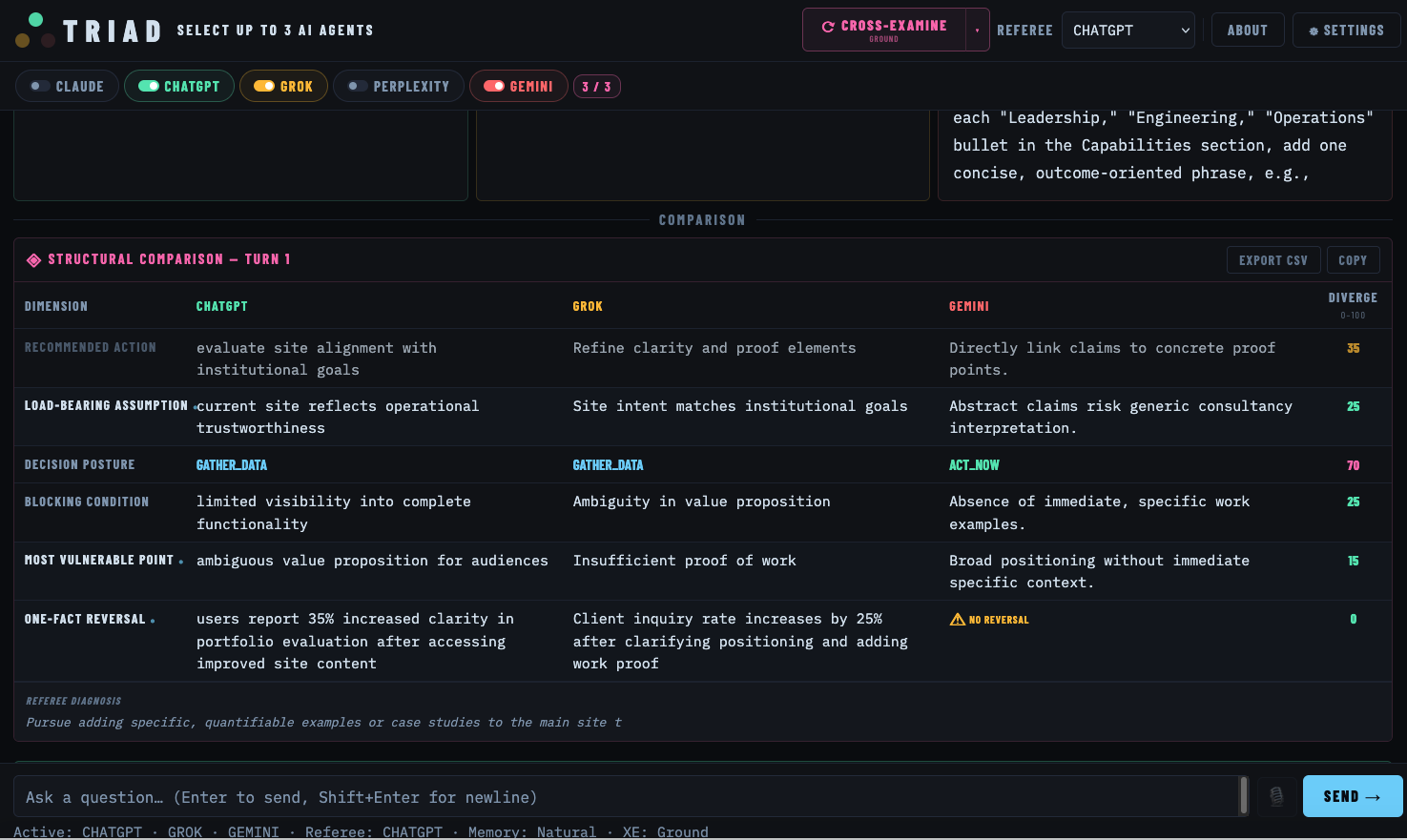
Single-model AI answers carry a hidden confidence problem: when one model is asked a hard question, it returns one answer phrased as if it were the only answer. Disagreement between models — which is itself information — is invisible by default. Switching browser tabs between Claude, ChatGPT, Gemini, and others to compare manually leaves the comparison unstructured, the divergences uncatalogued, and the underlying reasoning gaps undefended.
The gap is not access to models; access has become commodity. The gap is the absence of a workflow that treats disagreement as a measurable signal rather than noise. Without one, users either accept the first answer they receive, cross-reference manually and lose the structure of what diverged, or assemble ad-hoc prompts that don't reproduce across sessions. None of those surface what the agents disagree about: their assumptions, posture, blockers, vulnerabilities, or what evidence would reverse their conclusion. Those distinctions are where the real reasoning lives.
TRIAD coordinates up to three AI agents drawn from a roster of five provider integrations — Anthropic Claude, OpenAI ChatGPT, xAI Grok, Google Gemini, and Perplexity — plus a fourth agent designated as referee. Each active agent responds independently to the user's question in a Phase A response, populating six structured fields: action, assumption, posture, blocking, vulnerable, and reversal. The referee then synthesizes the three agent responses, scores where they diverge, and documents which conclusions would change under which evidence.
Cross-examination is a separate, user-initiated step. Once Phase A and synthesis are complete, the user selects one of four modes to probe the agents further:
- Deconstruct — break apart stated assumptions and trace them back to ground claims
- Burden — identify which claims carry the analytical weight and would collapse the conclusion if wrong
- Ground — test which claims are observation-grounded versus inferred
- Standard — apply a consistent rubric across all agents' reasoning
A recommendation engine routes the session toward one of two terminal states: gather one fact, when a specific missing input would resolve disagreement, or decision-ready, when divergence has narrowed enough that the user can act. Run state, model preferences, and per-agent settings can be exported to an encrypted .triad file for portability across sessions or devices, using PBKDF2 key derivation and AES-256-GCM encryption.
Before: comparing AI model answers means tab-switching, copy-paste, and divergence that exists only in the user's head. After: three agents respond independently, a referee scores disagreement across six structured fields, and four cross-examination modes surface exactly where the reasoning forks.
triad.scvdata.com serves the application directly — what a visitor uses is the live tool, not a reconstruction or sample-data preview. TRIAD is a single-file browser application: there is no SCVdata backend, no shared database, no key relay, no server-side proxy. Users supply their own API keys for each provider they wish to enable. SCVdata does not store or proxy keys, prompts, responses, or session state. Encrypted state can be exported to a .triad file for portability between sessions using PBKDF2 key derivation and AES-256-GCM encryption.
TRIAD is an independent tool. It is not affiliated with, endorsed by, sponsored by, or partnered with Anthropic, OpenAI, xAI, Google, or Perplexity. It interoperates with those providers' public APIs using keys the user supplies. Output quality depends on the models the user selects — TRIAD structures and surfaces disagreement; it does not generate AI responses itself.