
Hallmark & Hewitt — Archive File Management
Live — demo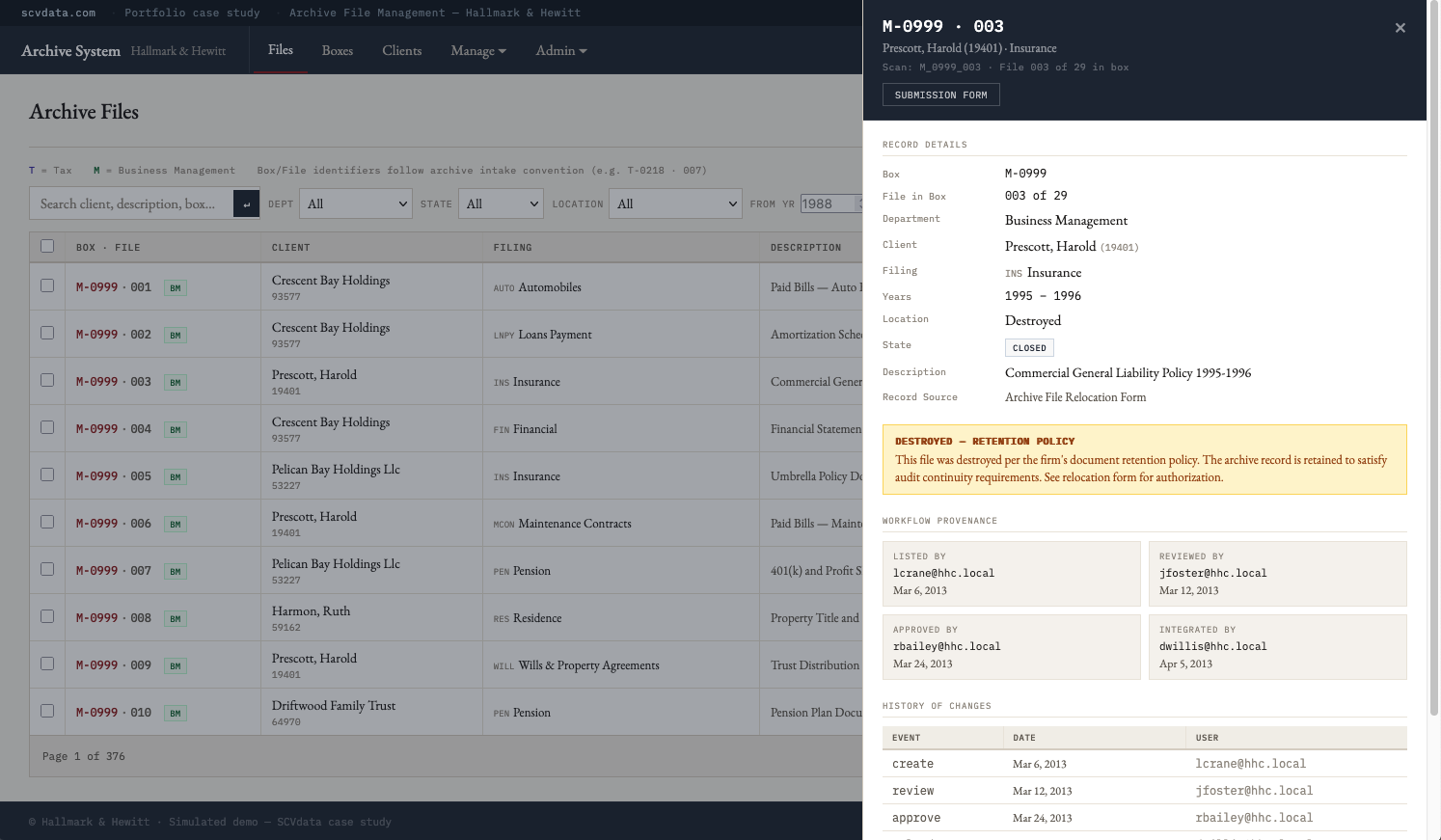
A professional services firm accumulates records in two directions at once: new work comes in, and old work gets archived — moved out of active file cabinets, boxed, labeled, and put into storage. Without a systematic index, what comes out of active storage effectively disappears. The only way to retrieve it is to know which box it's in, which room that box is stored in, and whether anyone has moved it. In a firm spanning two departments and decades of client history, that knowledge exists almost entirely in staff memory.
The specific failure modes are familiar in any records-heavy environment: files that can't be located, boxes that sit in a manager's office for weeks because no one has completed the intake steps, inconsistent naming that prevents searching, and no record of who handled what or when. When someone needs to retrieve a client document from twelve years ago, the time spent locating that file — or confirming it was destroyed — is time the firm absorbs as overhead. The system was built to make that retrieval reliable and fast.
The archive system functions as a structured index for the firm's physical filing operation, not a document storage platform. Every archive box gets a number. Every file inside that box gets a sequential file number within that box. Every record in the system carries the physical location of its box, its current workflow state, and — where available — a direct path to its scanned PDF on the firm's internal archive file server. The index covered both Tax and Business Management collections, each with distinct box numbering conventions, filing classifications, and storage destinations.
Intake was governed by a four-stage workflow: clerical staff listed box contents using a standardized submission form, management reviewed and signed off, a partner gave final approval, and a database integrator merged the list into the main index before the box could move to permanent storage. The system enforced this sequence by design. Every state transition was logged with the user who made it and the date it occurred, giving the firm a complete custody record for every file in the archive.
Major capabilities:
- Archive index — search and filtering by client, filing type, box, physical location, workflow state, and document year range
- Per-box file numbering — submission form view showing full box contents under standardized identifiers (e.g.
T-0218 · 007) - Four-stage intake workflow — Listed → Reviewed → Approved → Uploaded → Archived → Closed
- Role-based access — Partner, Management Staff, Clerical Staff, Database Integrator
- Physical location tracking — formal relocation handling for Library, Basement, Across the Hall, Returned to Client, Destroyed, Missing, and Reactivated states
- Full audit trail — user, date, and event type captured on every record
- Bulk operations — CSV import/export and bulk state/location editing across selected file sets
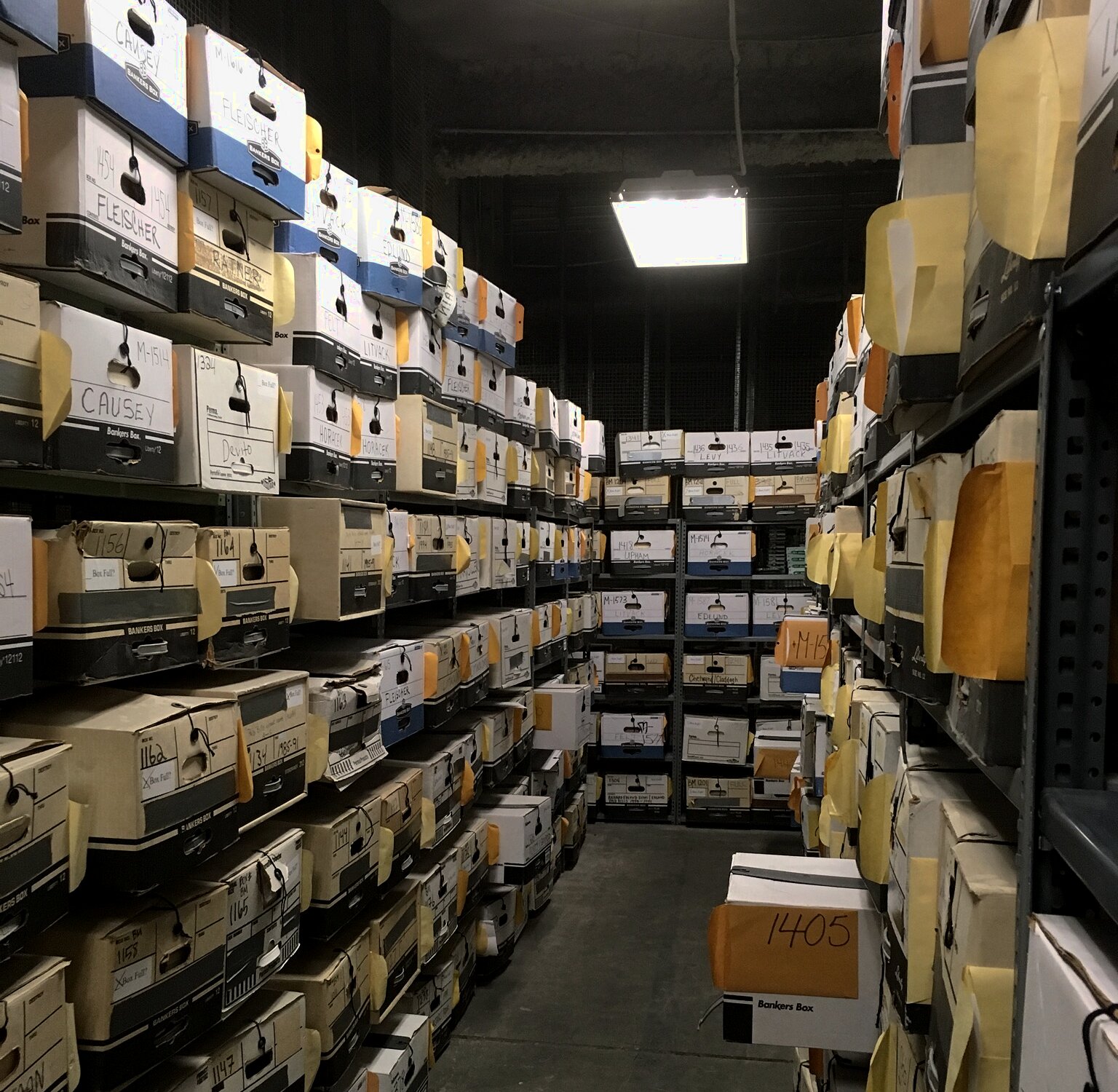
Before: physical filing rooms, handwritten box labels, no searchable index, and file retrieval dependent on staff memory — with no record of where a file had been or who had handled it. After: a structured archive index covering the full filing history of both departments, searchable by client, box, filing type, location, and year range, with a complete audit trail on every record and a direct link to the scanned file where available.
The demo at hhc.scvdata.com is a frontend-only reconstruction built as a single self-contained file with no backend or live database. All records, clients, boxes, and audit trail entries shown in the demo are fictional sample data generated to represent the scale and structure of the original system — not the actual production data, which was confidential client information. The original system was a browser-based intranet web application deployed on the firm's internal network, not a local desktop tool and not a cloud service. The demo reconstructs its interface, data model, and operational workflow using the original project artifacts as reference: correspondence, entity-relationship diagram, codebase, and the firm's internal archiving procedures manual. Public-safe credibility anchors: archive index covered over 35,000 files at operational scale; two departments (Tax and Business Management); four-stage intake workflow with four defined staff roles; demo reconstruction shows 126 boxes, 65 clients, and 3,754 sample records with validated year ranges, filing codes, and audit trail entries.
The demo is a reconstruction based on original project artifacts. It is not the production system. All client and staff data visible in the demo is fictional sample data generated to represent the scale and structure of the original archive. The production system operated on a private internal network and is no longer in active use. "Hallmark & Hewitt" is the anonymized identity used on this portfolio page.