
Fieldhouse Foods — Wholesale Food Operations
Live — demo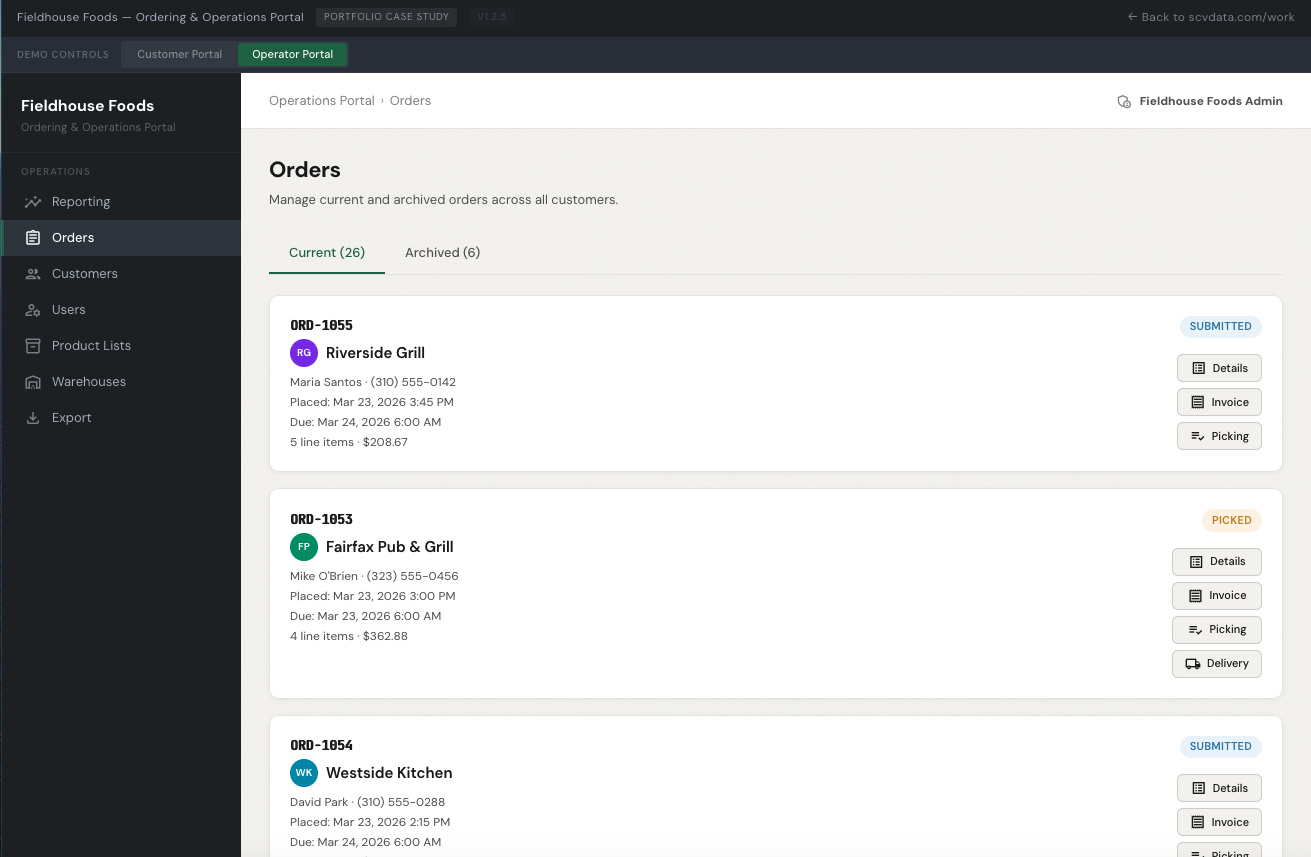
A regional food-service supplier serving approximately forty independent Los Angeles-area restaurants and delis was running wholesale procurement and customer ordering by phone, fax, and spreadsheet. Each restaurant placed standing or one-off orders against a custom product list that the operator maintained by hand. There was no shared digital record of what had been ordered, no shared visibility into pick or delivery status, and no reliable way to reconcile a day's activity without rebuilding it from paper at the end of each shift.
The operational consequence was that everyone — the operator, the warehouse pickers, the delivery drivers, and the customers — was working from a different incomplete picture. Customers couldn't see their own order history. Pickers were working from handwritten lists that didn't always reflect the latest call-in changes. Reconciliation against the upstream wholesale supplier was a manual end-of-month exercise. As the customer count grew, the manual coordination overhead grew faster than the order volume, and the system itself was becoming the constraint on the business.
A two-portal web application was built to replace the phone/fax/spreadsheet workflow with a single shared system of record. Each restaurant received its own curated product guide — the catalog filtered down to the items that specific account actually ordered, with case/unit-aware pricing, taxability, and catch-weight handling preserved. Customers placed orders directly. Operators managed the resulting queue from a separate operator portal, with the entire downstream workflow — pick, deliver, invoice, reconcile — captured in one chain.
The system was structured around the actual operational steps:
- Customer ordering — curated product guide, case/unit toggle, draft → submit flow, order history with line-item drill-down
- Operator queue — sortable order list with status, customer, total, and delivery date; per-order detail view with all line items
- Warehouse picking — bin-sorted pick lists grouped by warehouse and storage category (Dry Goods / Refrigerated / Frozen), printable
- Delivery tracking — status progression from picked through delivered, with delivery confirmation
- Invoicing — per-order invoice generation with tax, delivery fee, and any catch-weight adjustments applied
- Reconciliation export — CSV export of order line items, filterable by date, for matching against the upstream supplier's purchase records
- Back-office administration — customer, user, warehouse, and product-list management
The strongest data relationship in the system was the curated product list — each customer saw only the items assigned to that account, with that account's negotiated unit-of-measure preferences and taxability flags. The product catalog itself was sourced from Restaurant Depot, which functioned as the upstream wholesale inventory pool the operator was fulfilling against.
Before: phone-and-fax ordering against handwritten product lists, with no shared visibility between customer, picker, driver, or operator. After: every order captured, picked, delivered, invoiced, and reconciled inside one shared system, with each customer seeing only their own curated guide and history.
The production system was a custom web application with a database backend, built around Restaurant Depot as the upstream wholesale source. The demo at fieldhousefoods.scvdata.com is not the production system — it is a self-contained frontend reconstruction with anonymized seed data, built to make the original system's structure and workflow tangible without exposing real customer information, real product pricing, or real account history. The seeded data is fictional but patterned after the real operational shape of the system: roughly a dozen customers, several dozen products, a working order queue, and a printable pick → deliver → invoice → export chain. Public-safe credibility anchors from the original operational dataset: approximately 40 active restaurant and deli accounts, approximately 32,000 invoice line items processed across a representative seven-month window, and approximately 2,600 items in the active product master.
The demo is an anonymized reconstruction with synthetic data. The interface and workflow are drawn from a real B2B food-service distribution system built for a regional Los Angeles-area supplier; the underlying client identity, customer accounts, product master, and order history are not exposed. "Fieldhouse Foods" is the anonymized identity used on this portfolio page.